
Introduction
Medicaid billing trips up many providers because state rules, managed care plans, and retroactive eligibility create complexity. The problem: missed authorizations, wrong payer handling, and state-specific timely filing rules lead to delayed or denied payments. The clear answer: adopt a state-aware workflow, verify eligibility, track filing limits, and use targeted documentation checklists. This post promises a practical, state-by-state overview plus checklists you can apply immediately to improve reimbursement and reduce rejections.
Deep Explanation of Medicaid billing
How Medicaid billing differs from Medicare and commercial plans
Medicaid billing is state-administered, meaning coverage rules, fee schedules, and provider enrollment vary by state. Unlike Medicare’s federal rules, Medicaid often requires separate state NPI/contracting, and many members are enrolled in managed care organizations (MCOs) that have unique claim submission portals and prior authorization paths. Commercial payers lean on standardized CPT/ICD rules and uniform contracts; Medicaid blends payer-specific edits with program-level eligibility checks.
Prior authorization and managed care nuances
Prior authorization for Medicaid frequently requires state or MCO-level forms and specific clinical justifications. For behavioral health, durable medical equipment, and specialty drugs, many states mandate prior auth before services. When patients are in MCOs, confirm the correct payer ID and submission method—failing to route to the MCO instead of the state Medicaid program is a top denial cause.

Real Examples / Case Study
Challenge: A multi-specialty clinic in State A faced 35% initial denials on Medicaid claims due to missed prior authorizations and wrong payer routing.
Solution: The clinic implemented a three-step fix — eligibility verification at check-in, a pre-bill audit for prior auth and MCO routing, and a timely filing tracker mapped to each state rule.
Results: Within 90 days denials dropped from 35% to 9%, A/R days fell by 22%, and monthly Medicaid reimbursements rose 14% as backlogged claims were refiled within state retroactive windows.
Visual Breakdown
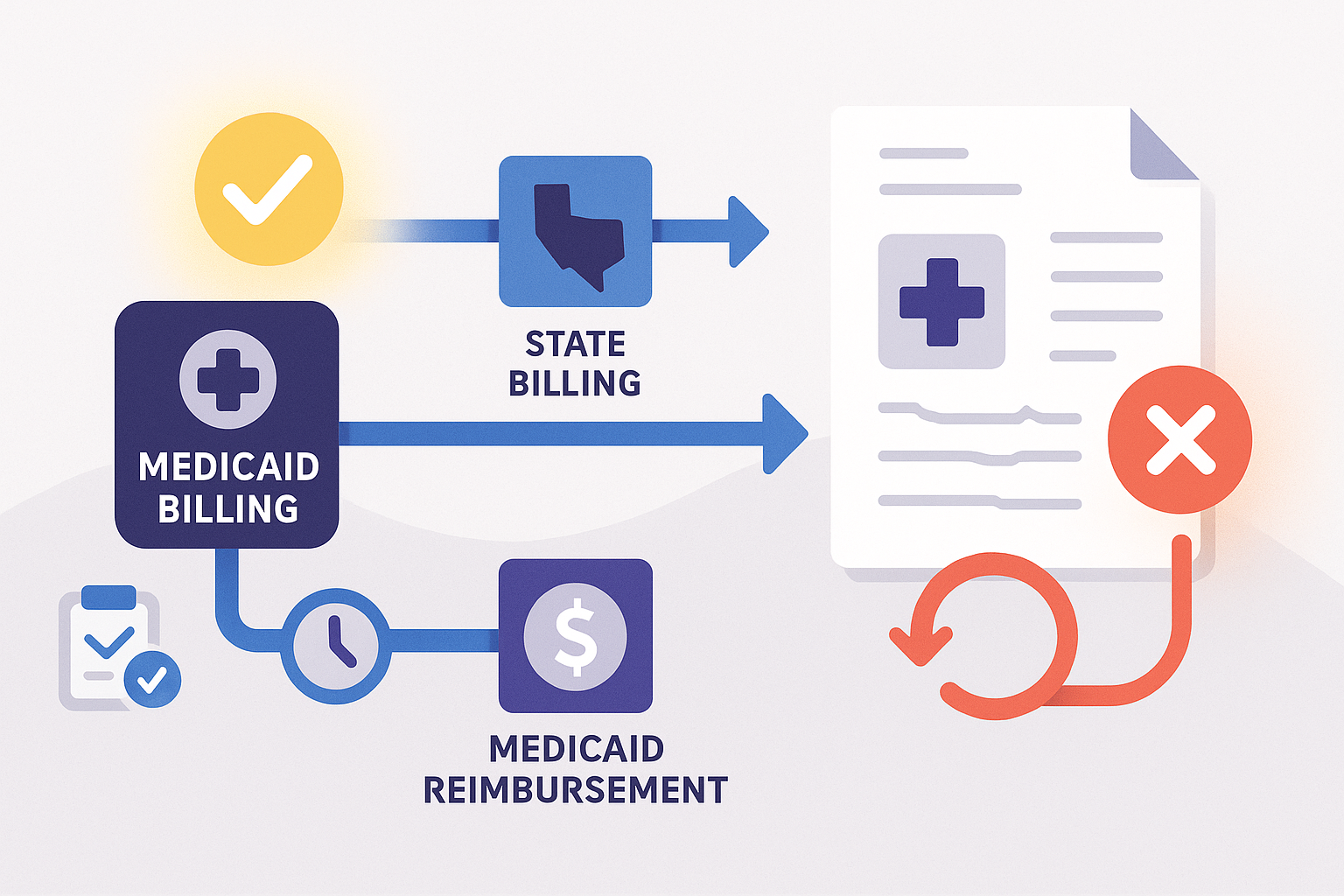
Workflow / process comparison:
- Step 1: Eligibility verification — confirm Medicaid ID, active dates, and MCO assignment at intake.
- Step 2: Prior authorization — check state and MCO prior auth rules before service scheduling.
- Step 3: Claim submission — route to state or MCO portal with correct payer ID, place required attachments.
- Step 4: Track timely filing — map each claim to state limits and calendar deadlines.
- Step 5: AR recovery — escalate denials within state appeals windows and pursue retroactive eligibility claims.
Quick Insights
- Automate eligibility checks at check-in to catch retroactive coverage immediately.
- Keep a state-specific timely-filing matrix accessible to billing staff.
- Train front desk on MCO identification and referral authorization workflows.
- Use claim scrubbing that includes state Medicaid edits before submission.
- Document clinical necessity clearly when submitting prior authorizations to speed approvals.
Mistakes to Avoid
- Wrong: Submitting claims to the state when an MCO is responsible. Correct: Verify payer assignment and use the MCO portal when required.
- Wrong: Waiting until month-end to check eligibility. Correct: Verify coverage at every patient encounter.
- Wrong: Minimal documentation for prior auth. Correct: Attach concise clinical notes and supporting codes during authorization submission.
- Wrong: Ignoring state timely filing variations. Correct: Maintain a state-by-state filing calendar and automated reminders.
Medicaid billing Checklist
- Verify member ID, effective and retroactive dates at intake.
- Identify MCO vs. state fee-for-service and select correct payer ID (eligibility verification workflow).
- Confirm prior authorization requirements and document clinical justification.
- Attach all required medical records and authorization approvals at claim submission (claim submission).
- Track state-specific timely filing limits and set calendar alerts.
- Refile or appeal within retroactive eligibility windows; escalate to AR recovery if unpaid.
- Maintain credentialing and enrollment renewals to prevent payment holds (revalidation and recredentialing).
Mistop Reasons Claims Are Rejected
- Missing or incorrect Medicaid ID numbers
- Expired provider enrollment in a state
- Submission to the wrong payer (state vs. MCO)
- Missing prior authorizations or inadequate clinical documentation
- Timely filing past state deadlines
- Code or modifier mismatches with state fee schedules
FAQs
1. How do timely filing limits vary by state?
Timely filing varies widely—some states allow 90 days, others 1 year. Always check the state Medicaid provider manual and map limits per payer.
2. What is retroactive Medicaid eligibility?
Retroactive eligibility covers services provided before enrollment if the patient was eligible during that prior period; providers can submit backdated claims per state rules.
3. How do I handle Medicaid managed care plans?
Confirm MCO enrollment, use the MCO’s billing portal when assigned, and follow the MCO’s prior authorization process.
4. Are Medicaid authorizations different from commercial ones?
Yes—states and MCOs may require state-specific forms, different documentation, or pre-service review steps not used by commercial payers.
5. What documentation helps prevent denials?
Include clear clinical notes, supporting ICD/CPT codes, prior auth approvals, and any state-required forms or attachments.
6. Can I appeal a Medicaid denial?
Yes—appeals must follow state timelines and procedures; document clinical justifications and submit within the appeal window.
7. How to track multiple state rules efficiently?
Create a centralized state matrix with filing limits, contact points, and prior auth rules; automate reminders where possible.
8. When should I refile for retroactive eligibility?
Refiling should occur as soon as retroactive eligibility is confirmed and within the state’s backdating window—often 90–180 days but varies.
9. How do credentialing lapses affect payments?
Lapsed enrollment can cause claim rejections; maintain renewals and revalidation to ensure continuous payment eligibility.
10. Should I outsource Medicaid billing?
Outsourcing to experienced RCM partners can reduce denials, maintain state compliance, and improve cash flow—especially for multi-state practices.
Conclusion
Recap: Medicaid billing requires state-aware processes: verify eligibility, respect MCO routing, meet prior authorization rules, and monitor timely filing. Reinforce these steps with a checklist and state matrix to reduce denials and speed payment. Ready to streamline your Medicaid workflow and reclaim lost revenue? Contact our team to get a tailored state-by-state billing audit and implementation plan.