Introduction
physical therapy billing is one of the most error-prone revenue drivers for PT practices and rehab clinics. Missed timed codes, improper modifiers, and weak documentation cause denials, delayed cash, and frustrated clinicians. This guide explains timed vs untimed CPTs, the 8-minute rule, KX modifier use, Medicare therapy rules, and payer-specific coverage — plus a practical 10-point denial prevention checklist you can apply today.
Deep Explanation of physical therapy billing
Timed vs Untimed CPT Codes in physical therapy billing
Timed CPT codes (e.g., 97110, 97112, 97140) require reporting units based on documented face-to-face minutes with the patient. Untimed codes (e.g., 97150 group therapy, 97750 assistive technology) are reported once per service regardless of minutes. Accurate charge-entry depends on distinguishing these and mapping clinical notes to minutes.
The 8-minute rule and unit calculation
Medicare’s 8-minute rule governs how many units to bill for timed codes: a single unit is billed when at least 8 minutes of a timed CPT is documented during an encounter. Use cumulative minutes across services to determine additional units (e.g., 16–23 minutes = 2 units). Always document start/stop or total active treatment minutes tied to specific CPTs.
KX modifier, therapy cap, and exceptions
When Medicare therapy thresholds are exceeded, append the KX modifier to indicate medical necessity beyond the therapy cap. KX doesn’t guarantee payment; it certifies that documentation supports continued services. For practices using outsourced partners, coordinate the KX process during claim submission to avoid interim denials and manual appeals.
claim submission workflow is essential when coding timed services to ensure correct units, modifiers, and bundling rules before sending to payers.

Real Examples / Case Study
Challenge: A 12-provider outpatient rehab clinic had a 22% denial rate on therapy services and inconsistent unit calculation for timed CPTs.
Solution: We standardized documentation templates to capture active treatment minutes, trained front-desk eligibility checks, applied KX modifier workflows, and implemented daily claim scrubbing for timed codes.
Results: Denials dropped from 22% to 6% in 90 days, average days in A/R decreased from 62 to 28, and monthly PT revenue increased by 14% (net gain $24,800/month).
Visual Breakdown
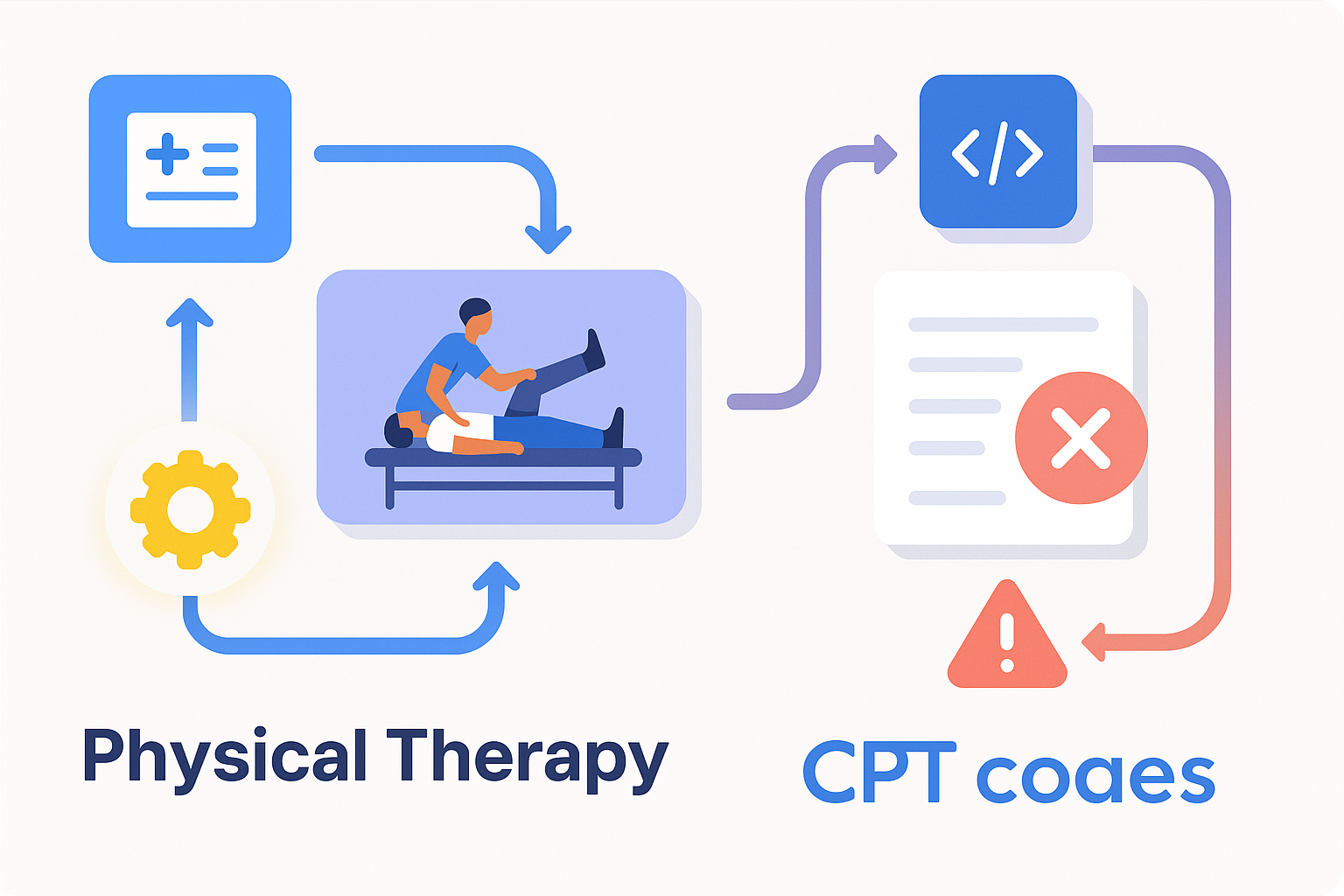
Workflow: Patient intake → functional limitation assessment → timed minutes recorded in therapy note → charge entry with units and modifiers → claim scrubbing → claim submission → payer-specific follow-up. Compare manual vs automated charge-entry: manual entry has higher transcription errors and missed units; automation plus validation reduces denials and speeds cash flow.
- Timed CPT code reference: 97110 (therapeutic exercise), 97112 (neuromuscular reeducation), 97140 (manual therapy), 97150 (group therapy – untimed), 97530 (therapeutic activities), 97161-97164 (PT evaluation levels).
Quick Insights
- Audit one week of notes monthly to validate minute-based billing and reduce unit errors.
- Train clinicians on the 8-minute rule and require minutes in every therapy note.
- Use the KX modifier only with clear supporting documentation and a signed plan of care.
- Create payer-specific coverage tables in your EHR to flag non-covered CPTs at charge entry.
- Implement a pre-bill claim-scrubbing pass to catch unit, modifier, and bundling issues.
Mistakes to Avoid
- Wrong: Billing multiple units without documented minutes. Correct: Document active treatment minutes and tie them to CPT codes.
- Wrong: Applying KX modifier automatically after cap. Correct: Use KX only with documented medical necessity and signed plan of care.
- Wrong: Treating untimed codes like timed services. Correct: Bill untimed codes once per visit per payer rules.
- Wrong: Ignoring payer-specific LT/RT or modifier requirements. Correct: Maintain payer policy matrix and update monthly.
FAQs
1. What is the difference between timed and untimed CPT codes?
Timed codes require counting treatment minutes for unit calculation; untimed codes are billed once per service. Always map notes accordingly.
2. How does the 8-minute rule work?
Medicare uses 8 minutes as the threshold per unit: 8–22 minutes = 1 unit, 23–37 = 2 units, etc., based on cumulative minutes across timed services.
3. When should I use the KX modifier?
Use KX when therapy services exceed Medicare thresholds and you have documentation supporting continued medical necessity and an active plan of care.
4. What documentation supports functional limitation reporting?
Document specific functional deficits (e.g., gait distance, ADL limitations), measurable goals, minutes of skilled intervention, and progress notes tied to interventions.
5. How do payer-specific coverage policies affect billing?
Private payers vary in covered CPTs, allowed units, and modifier rules. Maintain an up-to-date policy table and train staff to check eligibility per visit.
6. Can group therapy be billed as timed services?
Group therapy codes like 97150 are generally untimed and billed once per session per payer guidance; check payer policies for limits.
7. What triggers a therapy denial most often?
Common triggers: missing minutes, absent plan of care, wrong units, missing modifiers, and services considered not medically necessary.
8. How should appeals for therapy denials be handled?
Attach specific documentation demonstrating functional limitations, progress, and medical necessity; reference payer policy and include signed plans of care.
9. Do telehealth therapy sessions follow the same rules?
Payer policies vary — document modality, time, and clinical necessity; some payers limit or exclude certain timed codes in telehealth settings.
10. Should I outsource physical therapy billing?
Outsourcing can reduce denials and speed collections if the partner provides RCM expertise, payer policy maintenance, and daily claim scrubbing.
Conclusion
Recap: Clear documentation of minutes, correct use of timed vs untimed CPTs, proper KX modifier application, and payer-aware charge-entry are the pillars of efficient physical therapy billing. Reinforce training, adopt a monthly audit, and use claim-scrubbing tools to protect revenue. Ready to reduce denials and speed collections? Contact our team for a demo and revenue assessment.